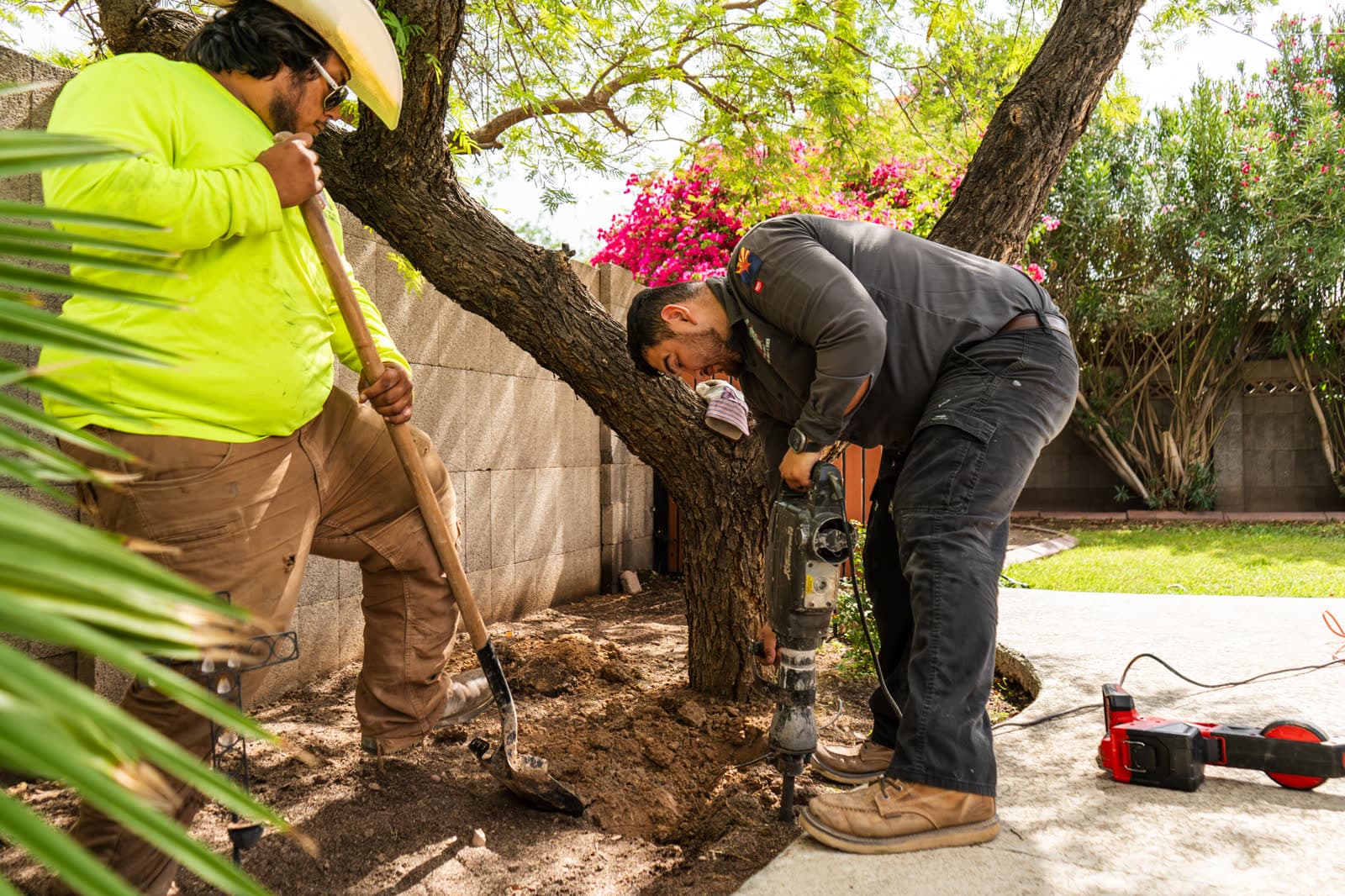
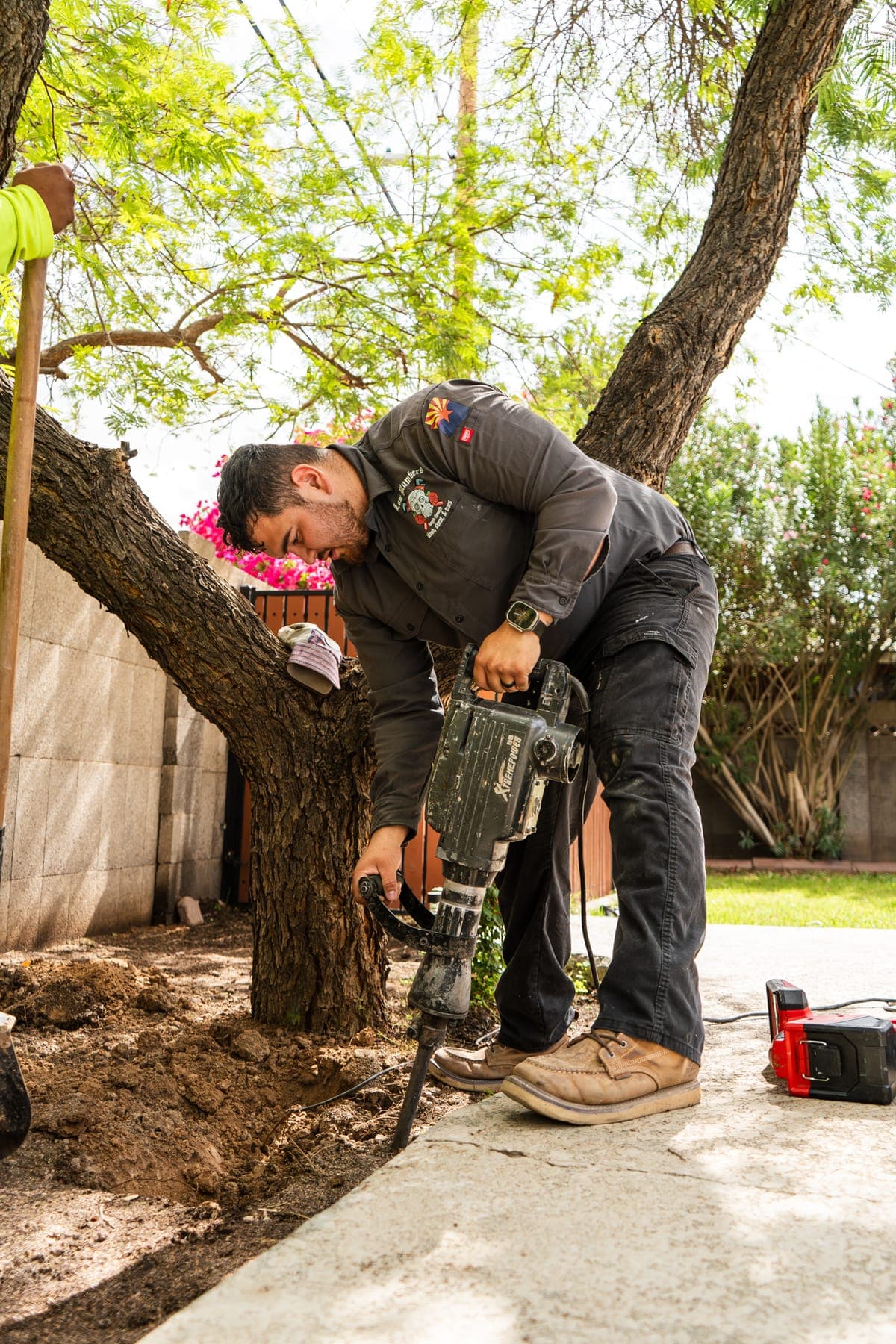
Desert trees are good at one thing above everything else: finding water. In a yard that gets watered twice a week, the most reliable moisture around is the sewer line a few feet down.
So roots find it. If your drains slow down every year around the same time, a plumber clears them, and a year later it happens again, this post is about your house.
The trees that do the damage here
Any tree can get into a broken pipe, but a few show up in our camera footage far more than the rest.
- Ficus. The worst offender by a wide margin. Fast growth above ground means fast, water-hungry roots below it, and a ficus planted near a sewer line will find it.
- Citrus. Older Mesa and Tempe neighborhoods are full of grapefruit and orange trees planted decades ago, often right over the original clay sewer line.
- Palo verde. Built for drought, which means roots that range wide and go wherever the moisture is. A sewer line is a straight trail of it.
- Mulberry. An older-yard shade tree with roots nearly as pushy as a ficus.
The roots do not smash their way in. A buried sewer line breathes a little moisture at every joint, a root follows that moisture to the joint, and a feeler thinner than a hair slips through the gap. Then it thickens, branches, and starts catching everything you flush.
That is why pipe material matters. Clay pipe, standard here before the 1970s, has a joint every few feet. Cast iron rusts open at its joints and along its bottom, while the glued plastic pipe in newer homes gives roots almost nothing to enter.
Most of our root calls come from the older grid: central Mesa, Tempe, and Apache Junction, where clay lines and 50-year-old trees share the same yards. A newer build in Queen Creek with plastic pipe almost never has this problem.
Cutting roots every year is a subscription
The standard fix is mechanical. A cable with a blade, or a hydro jetter, cuts the roots out and the drain flows again. Nothing wrong with that as a repair, but look at what happens next.
The roots grew in through an opening that is still there. Cutting a root works like pruning a branch: it grows back from the same spot, often thicker. Most root-choked lines we see are on an annual cycle, cleared every spring and blocked again by the next one.
A camera run after the cleaning shows you where you stand. It shows every joint the roots are entering, whether those joints have shifted, and how much sound pipe is left between them. We run the camera with you watching, because the footage is the whole argument.
One thing that does not fix it: removing the tree. You lose 30 years of shade, the roots already in the pipe keep blocking it until they rot out, and the joints stay open for the next tree.
When cutting is enough, and when lining ends it
Cutting is the right call when the camera shows light roots at one or two joints and sound pipe everywhere else. Clear it, note it, check it again in a year or two. Paying for occasional maintenance on a mostly-good line is reasonable.
The math is worth doing out loud. A yearly cleaning costs a little, every year, forever. A liner costs more once and ends the cycle, so which side wins depends on your pipe, your trees, and how long you plan to keep the house.
Lining is how the cycle actually ends. A cured-in-place liner is one continuous pipe with no joints, so every gap the roots were using gets sealed in a single pass. Roots cannot enter a pipe that has no openings.
We install the liners ourselves with Picote and Maxliner gear, usually through the cleanout in one day. The pipe does need to hold its shape for a liner to work. That is the first thing the camera confirms.
When roots have worked a line long enough, a section can collapse. At that point lining is off the table for that section and it has to be dug, which is the argument for dealing with a root line before it gets there.
If your drains slow down every year
Book the cleaning, but ask for a camera run afterward and watch it. You are looking for two things: where the roots come in, and whether the pipe between those points is still sound.
Then decide with real information. Light roots in good pipe, keep cutting on a schedule. Roots in every joint of a 60-year-old clay line, seal it once and stop paying every spring.
Either way, call us. We will put the camera down the line and show you exactly what your pipe looks like before anyone talks price.