A few times a month someone hands us a sewer estimate from another company that costs more than their first car did. It says dig. Trench the yard, cut the driveway, replace the whole line.
Sometimes that dig is the right repair. Often it is not. There is a second way to fix the same pipe without opening the ground, and most homeowners have never been offered it.
We do both kinds of repair with our own crew. So this is the honest version: how each one works, when each one wins, and what the cost difference really looks like.
How each repair actually works
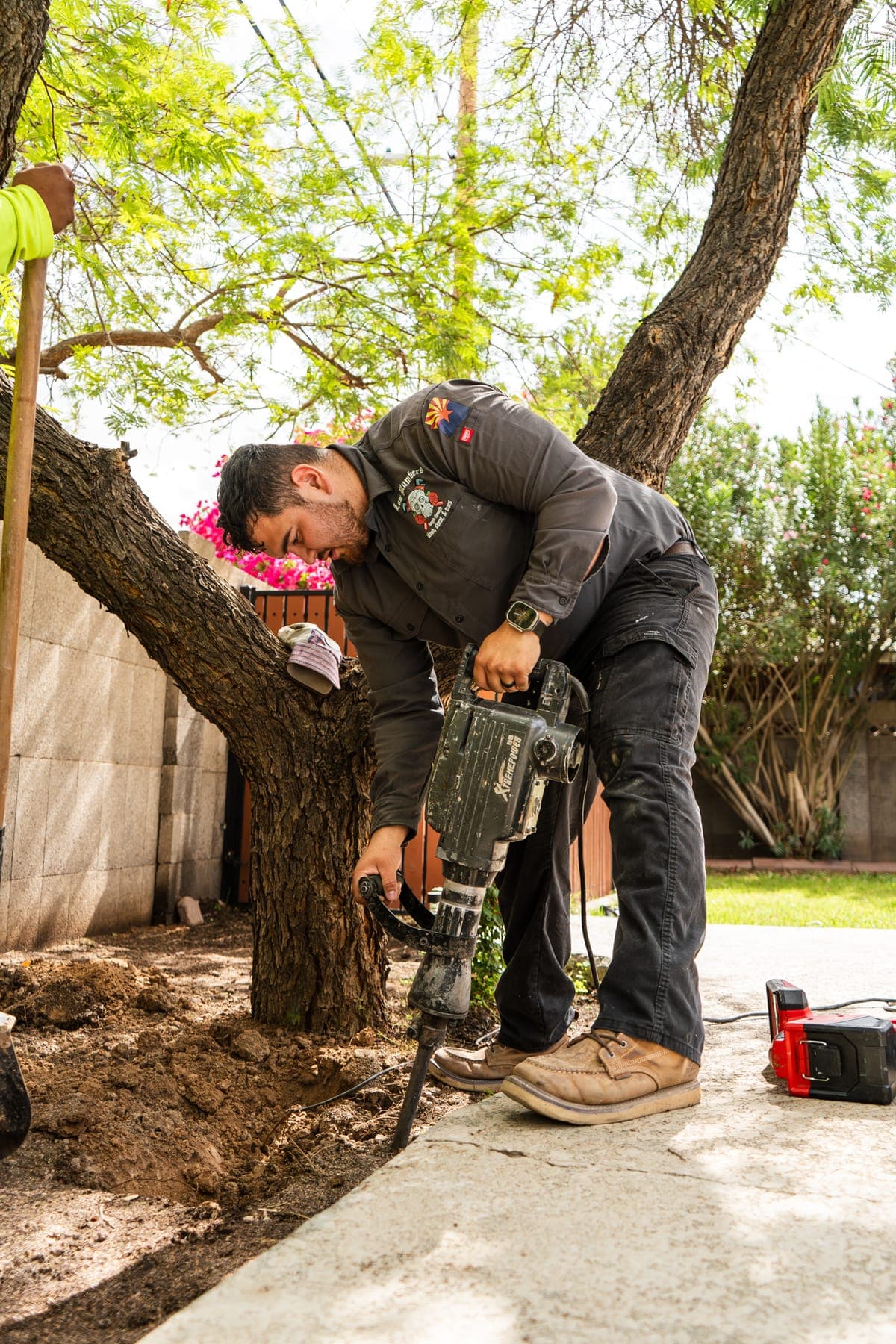
Dig-and-replace is what it sounds like. An excavator opens a trench along the bad section or the whole run, the old pipe comes out, and new pipe goes in.
The plumbing part of a dig is simple. The expensive part is everything sitting on top of the pipe: turf, block walls, paver driveways, pool decking, and the mature trees that took 30 years to grow. In an established Mesa yard, putting all of that back can cost as much as the pipe.
Trenchless lining works from inside the pipe instead. We clean the line back to bare wall, then pull a resin-soaked liner through it and cure it in place. The old pipe becomes the mold, and you end up with a new jointless pipe inside the old one.
We run Picote and Maxliner equipment and our own crew does the lining. Nothing gets subbed out. Most linings go in through a cleanout or one small access pit and are finished in a day.
Both repairs end with the same test. We camera the finished line, and you see the new pipe before we call the job done.
When lining wins, and when digging honestly does
The camera decides this, not a sales pitch. A liner needs a host pipe that still holds its shape, and a dig needs a reason good enough to justify tearing up what is above it.
Lining usually wins when:
- The pipe is cracked, root-cut, or scaled but still holds its shape. Old clay and cast iron in this condition line very well.
- Something expensive sits on top of the line. A paver driveway, a pool deck, a block wall, or the slab itself.
- Mature trees shade the yard. An excavator does not go around a 40-year-old tree, it goes through its roots.
- You are living in the house during the repair. Lining is usually a one-day job with the water back on that night.
- The line runs under the slab. Cast iron under a Valley slab-on-grade home is the classic case, because the alternative is jackhammering floors.
Digging genuinely wins when:
- The pipe has collapsed. A liner needs an open channel to pull through, and a fully flattened section leaves nothing to line.
- The line is badly back-pitched. A liner follows the host pipe exactly, so it cannot fix a slope that was wrong from the start.
- The run is short and shallow in open dirt. If an excavator reaches the pipe in an hour and nothing above it matters, a dig can honestly cost less.
- The line needs to be upsized. A liner slightly narrows the pipe it goes into, so a pipe that was too small stays too small.
We own the excavator too, so we have no reason to steer you either way. The camera footage makes the call, and you can watch it with us.
What the cost difference really looks like
Nobody can price a sewer line honestly without a camera in it first. Depth, length, access, and what sits above the pipe move the number more than the pipe itself does.
Here is the relative truth. On a dig, the trench and the restoration are where most of the money goes. Lining removes almost all of that, because nothing above the pipe gets touched.
We often meet homeowners quoted $10,000 to $17,000 elsewhere for a full dig. On many of those lines, the camera showed a pipe we could line for a fraction of that.
It cuts the other way too. On a short shallow run in open dirt, the dig bid can come in under the lining bid, and when that is your line we will say so.
Holding a dig estimate right now? Bring it to us. We give free second opinions, and ours starts with a camera, not a number.
Before you sign a dig estimate
Ask for the camera footage of your own line, and ask the bidder to point at the reason lining will not work on it. A real answer names something specific: a collapse, a bad slope, a crushed section. A vague answer is worth a second opinion.
Then call us. We will camera the line, show you what we see, and tell you which repair we would choose if it were our own house.